
How to Check Jefferson County Criminal History
Begin with the record that best matches the question. Judici provides public Jefferson County court case information. The Circuit Clerk supplies the official file, certified copies, exhibits, older material, and entries that are not online. The Jefferson County Sheriff's Office holds sheriff reports and booking records, while Illinois State Police products cover statewide conviction information or a person's own fingerprint record.
Gather the full name, likely spelling variants, date of birth when a system permits it, and any known case or incident number. Match several fields before treating a name result as the same person. A name-based hit is not fingerprint proof, and a jail charge is not the final court outcome.
Judici can be searched by person name or case number after Jefferson County is selected. Date and case-type filters may narrow a crowded result list. A docket description does not guarantee that the document image is free or even online. When an image, exhibit, certification, or archived file is missing, note the case number and ask the Circuit Clerk for the official record. The courthouse counter is also the route for pre-1987 material that Judici does not carry.
- Select Jefferson County in Judici and search by name or case number.
- Compare the filing date, case type, charge counts, and public party details.
- Read each count's disposition instead of relying on one case label.
- Check the sheriff app or call the Justice Center if present custody matters.
- Request the official file or fingerprint product when identity or certification matters.
The clerk counter is at the Jefferson County Courthouse, 100 South 10th Street, Mount Vernon, with criminal-record numbers 618-244-8007 and 618-244-8008. County government lists building hours of 8 a.m. to 4 p.m., while the newer clerk site lists counter hours of 8:30 a.m. to 4:30 p.m. Call before a late visit. The clerk accepts cash, money orders, and cashier's checks for criminal or traffic payments, but not personal checks. The county did not publish a full copy and certification fee schedule in the sources reviewed, so ask for the exact cost before ordering.
Jefferson Records Span Six Systems
No single search collects every local criminal record. Police or deputies write the incident report. The Justice Center makes the booking file. The State's Attorney chooses the filed charges, and the Circuit Clerk keeps the case. ISP receives reportable arrest cycles and outcomes. IDOC, federal prisons, and the registry maintain still other records.
The physical split matters as much as the digital one. Court, clerk, prosecution, and defense offices center on the courthouse at 100 South 10th Street. Sheriff administration, jail booking, custody, bonding, and local registration questions belong at 911 Casey Avenue. Sending a request to the wrong building can delay an otherwise simple search because one office is not the legal custodian for the other office's files.
The official Jefferson County site is the starting directory for courthouse offices. Its captured page below helps confirm that county government and the courthouse are the source for local department routing.
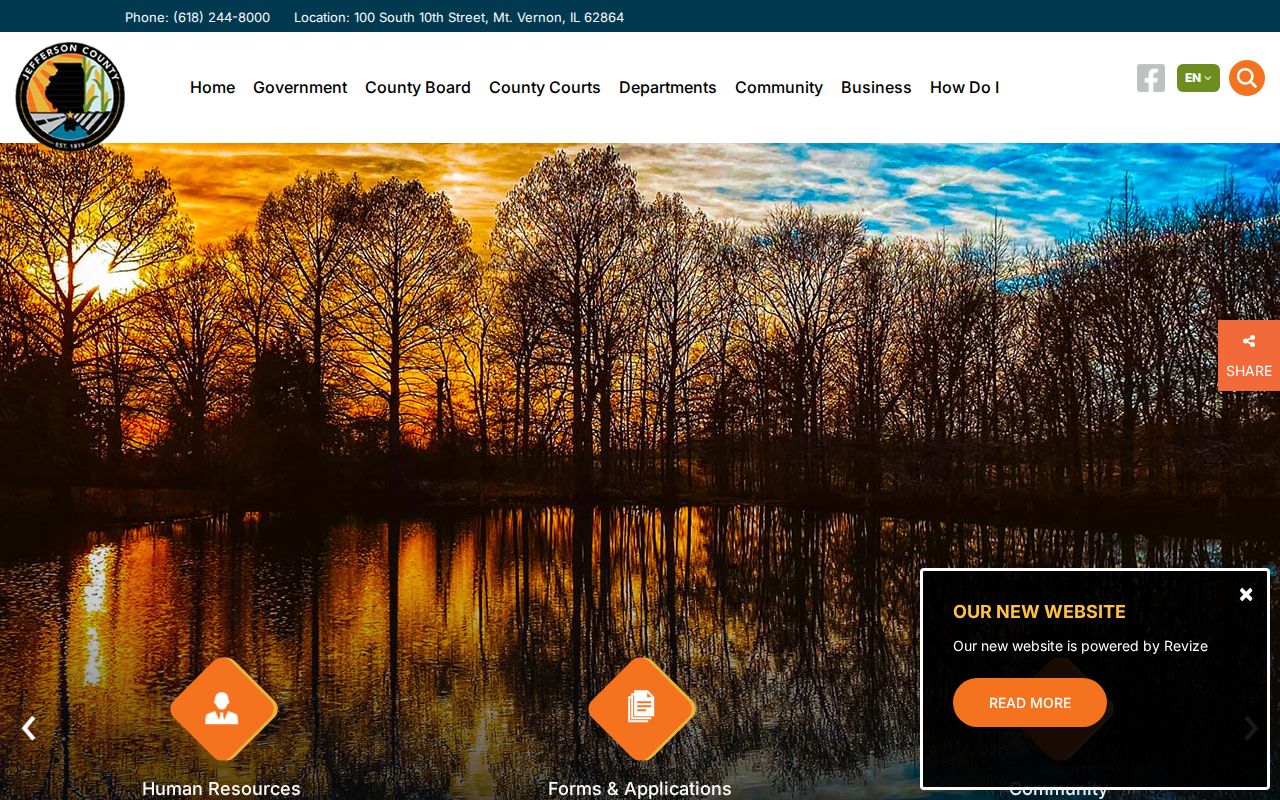
Use that county directory for the clerk, prosecutor, and public defender, then move to the sheriff or a state portal only when that office owns the requested record.
Circuit Clerk
100 S. 10th St., Mount Vernon, IL 62864
618-244-8007 or 618-244-8008
Filed cases, copies, certification, and archives
JCSO Records
911 Casey Ave., Mount Vernon, IL 62864
618-244-8004 ext. 333
Sheriff reports and historical booking requests
ISP Bureau
ISP.BOI.Customer.Support@illinois.gov
Statewide conviction inquiries, personal review, and challenges
The State's Attorney reviews referrals and files prosecutions but is not the public case-record custodian. The Public Defender provides court-appointed representation through judicial procedure and is not a search service. Even when those offices created a filing, the Circuit Clerk remains the source for the filed public copy.
Official Illinois Background Checks
The Illinois State Police Bureau of Identification is the central repository. Its CHIRP portal accepts public electronic name inquiries for conviction information. A name query costs $10 and can associate similar names, so it is not a fingerprint-confirmed match. Keep the Transaction Control Number used to retrieve the response.
For personal review, ISP Access and Review uses fingerprints from an ISP-licensed live-scan vendor. ISP charges no processing fee for that service, though the vendor may charge. It returns the person's transcript or a no-record response and includes a challenge form. Official checks for regulated purposes must follow the requesting agency's rules and should never be replaced by the sponsored search widget.
The ISP Bureau of Identification page describes the repository and its official request routes.
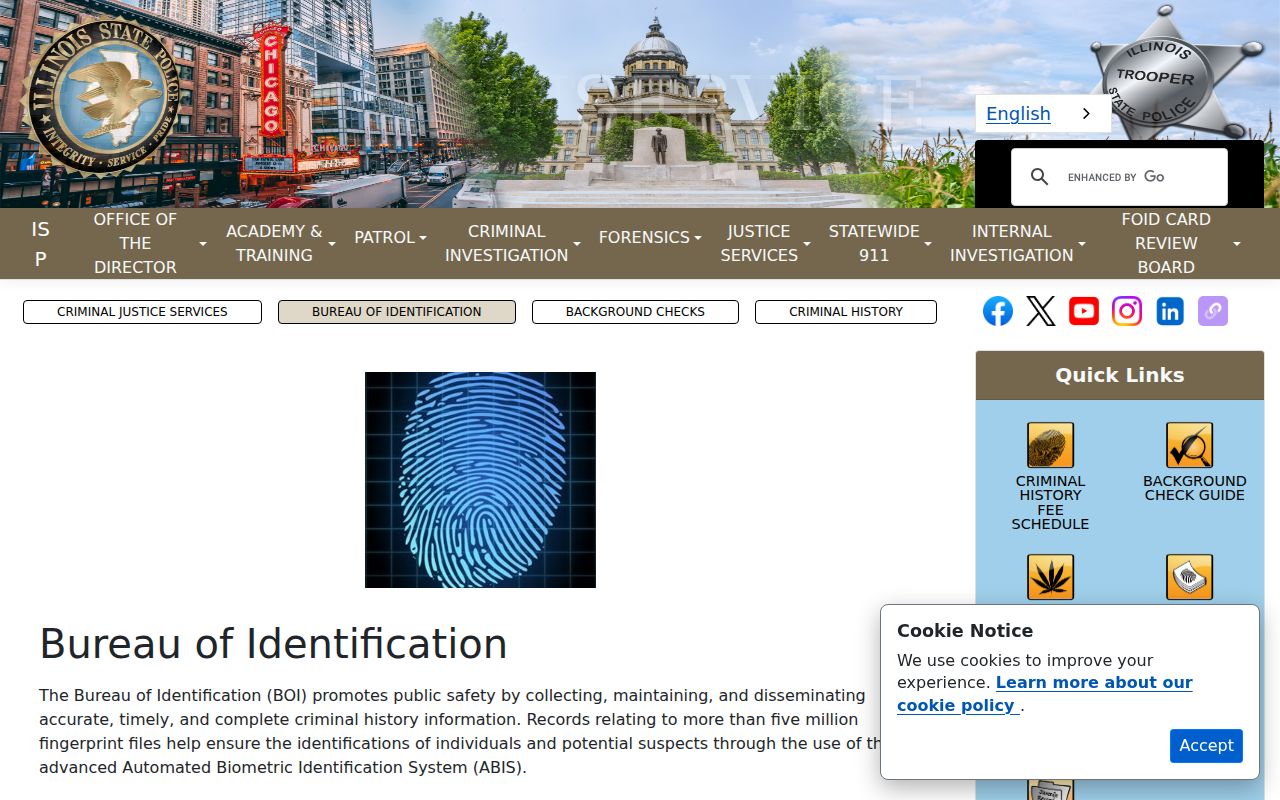
This state layer differs from the richer Jefferson County court docket and the sheriff's incident or custody files.
| Official product | Identity basis | Published fee |
|---|---|---|
| CHIRP electronic UCIA | Name and descriptors | $10 |
| Paper UCIA name inquiry | Name and descriptors | $16 |
| Electronic fingerprint UCIA | Fingerprints | $15 |
| Fingerprint card UCIA | Fingerprints | $20 |
| ISP Access and Review | Fingerprints | No ISP processing fee; vendor fee may apply |
Fee-purpose checks have their own state and FBI combinations. The requesting program should supply the correct purpose code and process. Do not choose a product merely because it is cheaper. The wrong request can answer a different legal question and may omit the material the authorized agency needs.
A licensed live-scan vendor captures fingerprints and sends them to ISP. The subject must use the correct request type and keep the transaction information. For Access and Review, ISP can mail the response to the subject or to the fingerprinting law-enforcement or correctional facility. A facility must notify the subject and release the response only to that person. An unclaimed response is destroyed after the documented holding period. This privacy-controlled process is distinct from an open public name query.
Choose Judici or CHIRP
Judici and CHIRP are not rival versions of the same file. Judici shows local case numbers, court events, counts, settings, public financial entries, and dispositions. CHIRP reports Illinois conviction information maintained by ISP. A new case can appear at the clerk before the corresponding state record updates. A dismissal in court also does not erase an arrest cycle by itself.
The CHIRP entry screen illustrates the state transaction route.
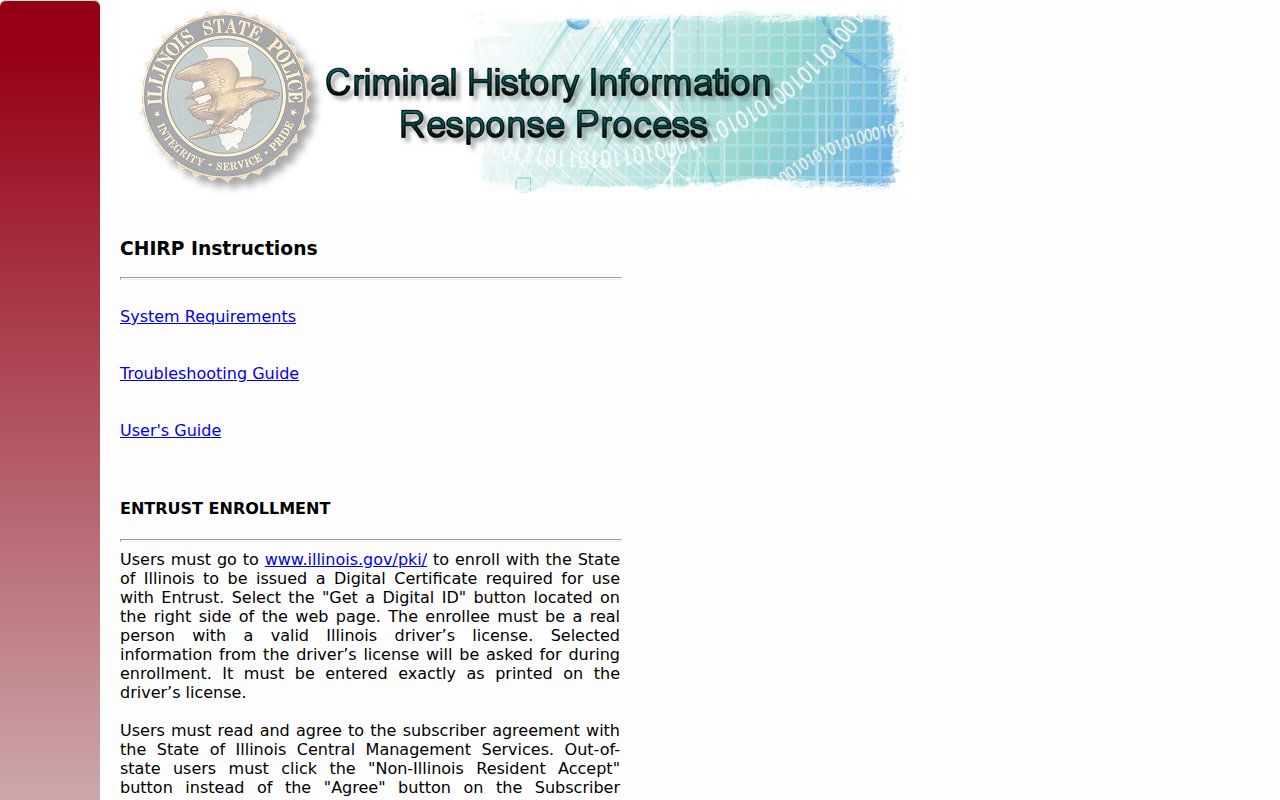
Use Judici when the question is what happened in a Jefferson County prosecution. Use CHIRP when the question concerns the state's public conviction-information product.
For the most reliable self-audit, compare the charge-level Judici outcome with ISP Access and Review. If ISP data appear incomplete or inaccurate, the transcript includes a Record Challenge form. Supply the event and disposition information requested by ISP. The Circuit Clerk can provide the signed order or certified disposition that supports the correction. This is more sound than submitting repeated name searches, which cannot resolve a biometric identity mismatch.
A Judici result should be read from the case header down. Confirm Jefferson County, the court number, case type, filing date, and status. Then review the parties, attorneys when public, each charge and statute, event history, upcoming schedule, and financial entries. A balance does not explain the whole judgment. Nor does one “closed” label explain how every count ended. If two people share a name, do not use a charge description as identity proof. The clerk can help locate the official file, but only fingerprint comparison can provide biometric confirmation.
Types of Criminal Records in Jefferson County
Record type determines the custodian. An officer's incident report may include the narrative and evidence details. Jail intake creates booking and release data. Prosecutors create formal charging papers, while the clerk maintains the docket, orders, outcome, and sentence. ISP groups qualifying arrest cycles and reported dispositions at the state level.
Warrants may involve both the issuing court and law enforcement. Probation judgments can appear in the public case, but operational supervision notes are restricted. The Illinois registry is a statutory publication, not a list of all people with criminal records.
- Incident and arrest reports: request these from the arresting agency.
- Booking and custody records: JCSO holds county jail intake and release data.
- Court case files: the Circuit Clerk keeps filings, events, orders, and judgments.
- State transcripts: ISP maintains fingerprint-supported cycles and reported results.
- Custody and registry entries: search JCSO, IDOC, BOP, or ISP according to the system.
Federal records remain outside both county portals. Jefferson County lies in the Southern District of Illinois, so federal criminal dockets use PACER. The FBI Identity History Summary is a subject-only fingerprint product. Federal prison custody appears through BOP, not the county jail or IDOC. Each is an additional layer rather than a broader replacement for local records.
Warrants and supervision records also require care. A judge issues a warrant, while law enforcement acts on it. The sheriff's selective Most Wanted display does not reveal all active court process. A public docket can show a probation judgment or later revocation filing, yet day-to-day Court Services notes stay restricted. Parole and mandatory supervised release belong to IDOC and the Prisoner Review Board after a prison sentence. These distinctions prevent a broad label such as “criminal history” from hiding who actually controls the source.
The Jefferson County Record Trail
An arrest by a deputy or local officer can produce four distinct files. The arresting agency keeps its report. Staff at 911 Casey Avenue make the intake record if the person enters county custody. The State's Attorney then decides what to file, and the Circuit Clerk creates the judicial case at 100 South 10th Street. Fingerprints may also start an ISP repository cycle.
The official sheriff site is the county source for custody, records requests, most-wanted information, and the mobile app.
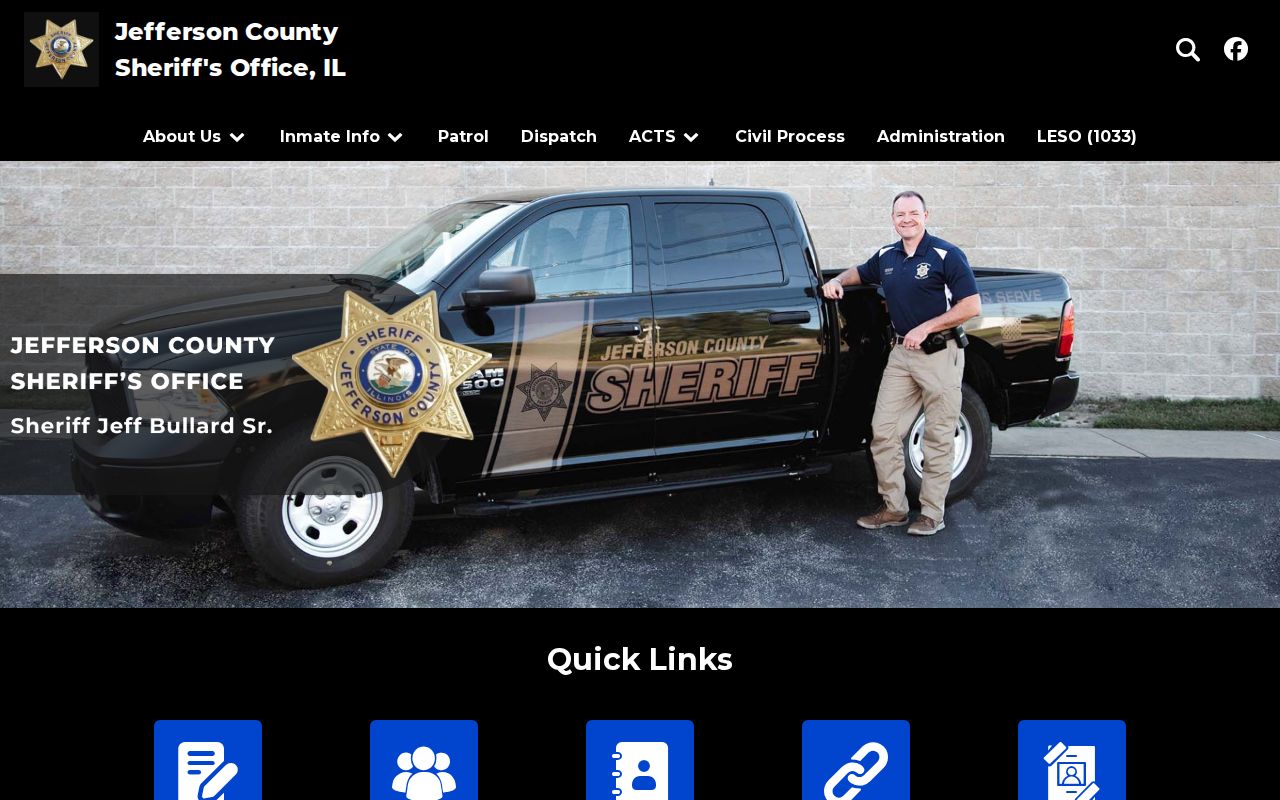
That split explains why a booking charge, the prosecutor's filed count, and the judge's final disposition can differ without any portal being wrong.
Timing creates another source of confusion. Intake staff record the legal authority and charge known at booking. Prosecutors may decline a count, amend it, or file a different classification after review. A judge then decides release or detention under Illinois's current pretrial law and later enters the case result. Repository reporting follows those local steps. A recent docket and the state transcript may therefore differ for a time.
The Circuit Clerk attends court and maintains criminal, traffic, DUI, juvenile, protection-order, and other files. The office also stores evidence introduced during jury trials. That duty shows why an online docket is only an index to the judicial record. It cannot substitute for every paper, exhibit, or certified order held by the clerk.
Illinois's current pretrial framework also changes what a recent file means. Routine cash bail is no longer the organizing rule. After arrest, a judge makes a release or detention decision under statutory standards. Older pages that describe every person as posting a percentage bond can be wrong. Read the current order and hearing entry instead. A release decision is not an acquittal, and detention before trial is not a conviction.
What a Jefferson County Criminal Record Shows
A record's fields reflect its purpose. A fingerprint transcript emphasizes identity and event cycles. A docket emphasizes court filings and decisions. A jail file emphasizes intake, physical custody, and release. Compare identifiers and read results count by count.
| Name & Identifiers | Names, aliases, birth data, descriptors, and state or federal identity numbers where lawfully shown. |
|---|---|
| Arrest / Booking Data | Agency, date, intake number, booking charge, fingerprints, custody status, and release or transfer. |
| Charges & Statutes | Each alleged or filed offense, its legal citation, count, and Illinois class. |
| Disposition | Pending, dismissed, nolle prosequi, guilty, not guilty, or another charge-level outcome. |
| Sentence | Custody, probation, fines, restitution, or other terms entered by the court. |
| Custody / Supervision Status | County detention, IDOC custody, release, probation, parole, or mandatory supervised release. |
Illinois terms need local context. “Nolle prosequi” means the prosecutor has stopped pursuing a charge at that time. It is not a conviction. “Supervision” is a distinct Illinois outcome whose later effect depends on the offense and successful completion. “Mandatory supervised release” is the state-prison release term often abbreviated MSR. A case with several counts can contain a conviction, dismissal, and amended charge at once, so the outcome must be read one count at a time.
A complaint or information is a formal accusation, not a finding of guilt. An indictment is returned by a grand jury and has the same basic caution. An arraignment is the stage when charges and a plea are addressed. The docket is the dated list of court activity, and the disposition is the result of a charge. “Pending” means no final result has been entered. “Not guilty” records an acquittal, while “guilty” records a judgment. These plain meanings help keep allegations, court process, and proven outcomes separate.
Identifiers also carry different weight. A State Identification number links fingerprint-supported Illinois history. A court case number links the clerk's file. An incident number belongs to the reporting police agency, while a booking number belongs to jail intake. Giving the correct number to the correct office is one of the fastest ways to avoid a false match or a failed records request.
Jefferson Sheriff App Access
The sheriff's browser page does not expose a conventional current-inmate roster. It directs readers to the OCV app and the search label “JEFFERSON COUNTY SHERIFF IL.” The app also links agency contacts, inmate tools, most wanted, sex-offender information, tips, news, and alerts. Those features are useful access points, but they do not prove that a complete warrant database exists.
The official OCV app landing page provides the supported mobile route.
If the app fails, call the sheriff at 618-244-8004, ask about current custody, or use the GovQuest public-records route for historical booking information.
Current custody and historical custody are separate requests. A person who was cited and released, transferred, booked under a spelling variant, or released before the search may not appear in the current tool. The lack of a live result does not settle whether an arrest occurred. Check the arresting agency report, ask JCSO for releasable booking or release data, and search for a later filed court case.
JCSO's current FOIA channel is GovQuest. It permits a new request, request tracking, and self-service searches. Anonymous filing is available, but an anonymous requester must retain the request number and security key. The records officer can be reached through the sheriff line at extension 333, and the portal lists jcsofoia@jeffersoncounty.illinois.gov.
For current custody, phone contact can resolve an app problem more quickly than a broad records request. For a past arrest, describe the exact booking, release, or incident material sought. If Mount Vernon Police made the arrest, request its officer report from the city even if JCSO later booked the person. If ISP made the arrest, use the state police channel. Custody at the Justice Center does not transfer ownership of another agency's report to the sheriff.
Public Access Laws for Jefferson County Criminal Records
Illinois law favors access to existing public records, but the correct office still matters. FOIA does not compel an agency to create research or obtain another custodian's file. Active-investigation details, confidential sources, private identifiers, juvenile material, victim information, and sealed records may be withheld or redacted. An ordinary noncommercial FOIA request generally receives a response within five business days.
Key Statutes:
5 ILCS 140 - The Illinois Freedom of Information Act controls requests for existing agency records and exemptions.
20 ILCS 2635 - The Uniform Conviction Information Act makes ISP conviction information available through its set process.
20 ILCS 2630 - The Criminal Identification Act governs repository reporting and expungement or sealing.
730 ILCS 150 - The Sex Offender Registration Act defines Illinois registration duties and categories.
Ask for a defined record, not a conclusion. A useful sheriff request includes an incident date and time, location, case number if known, type of incident, and whether inspection or copies are wanted. Illinois FOIA generally does not require a new summary to be written. The older JCSO form states that the first 50 black-and-white pages are free and later pages cost 15 cents each; color and oversized copies may be charged at actual reproduction cost.
When a request is denied, the response should identify the exemption. Review by the Illinois Attorney General's Public Access Counselor may be available. Court records follow clerk and judicial access rules rather than becoming ordinary agency files through FOIA. Registry information also has its own public-safety purpose and cannot lawfully be used to harass or threaten anyone.
Police media can involve added review. Body-camera video, dispatch records, 911 audio, crash material, and photographs may need redaction for private identifiers, juveniles, witnesses, victims, investigative methods, or safety concerns. A request should state the desired format and a tight time range. Large media files may carry reproduction costs not stated on the local page. An incident report documents an agency response and allegations; an arrest record documents custody; the court file documents prosecution. Request all three only when each answers a distinct need.
Remote court access may be narrower than courthouse access. Jefferson County also links Tyler's re:SearchIL, whose clearest free current coverage concerns nonconfidential reviewing-court documents filed on or after April 1, 2025. That does not mean every Jefferson trial-court document is online. Judici remains the county-linked basic case search, while the Circuit Clerk supplies the authoritative local file and answers questions about sealed access.
County Jail, IDOC, or BOP
Custody searches must follow the institution. JCSO covers people held at the Jefferson County Justice Center. The IDOC Individuals in Custody search covers the state prison system, not local jail bookings. The federal Bureau of Prisons locator is a third, separate source.
The official IDOC search page below shows the state-level custody channel.
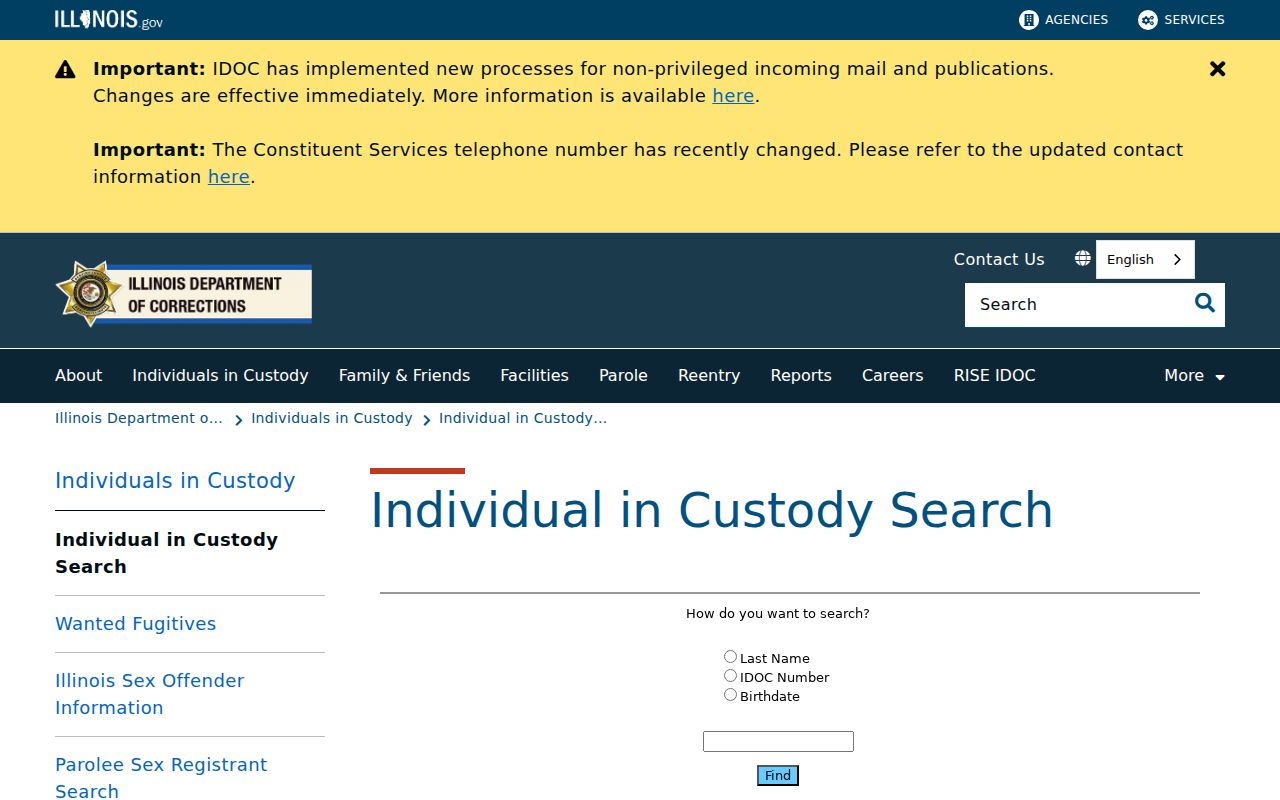
After release from an Illinois prison sentence, IDOC Parole Division supervises parole or mandatory supervised release while the Illinois Prisoner Review Board handles release decisions and conditions.
The Prisoner Review Board site identifies that distinct authority.
For federal custody, use the BOP inmate locator.
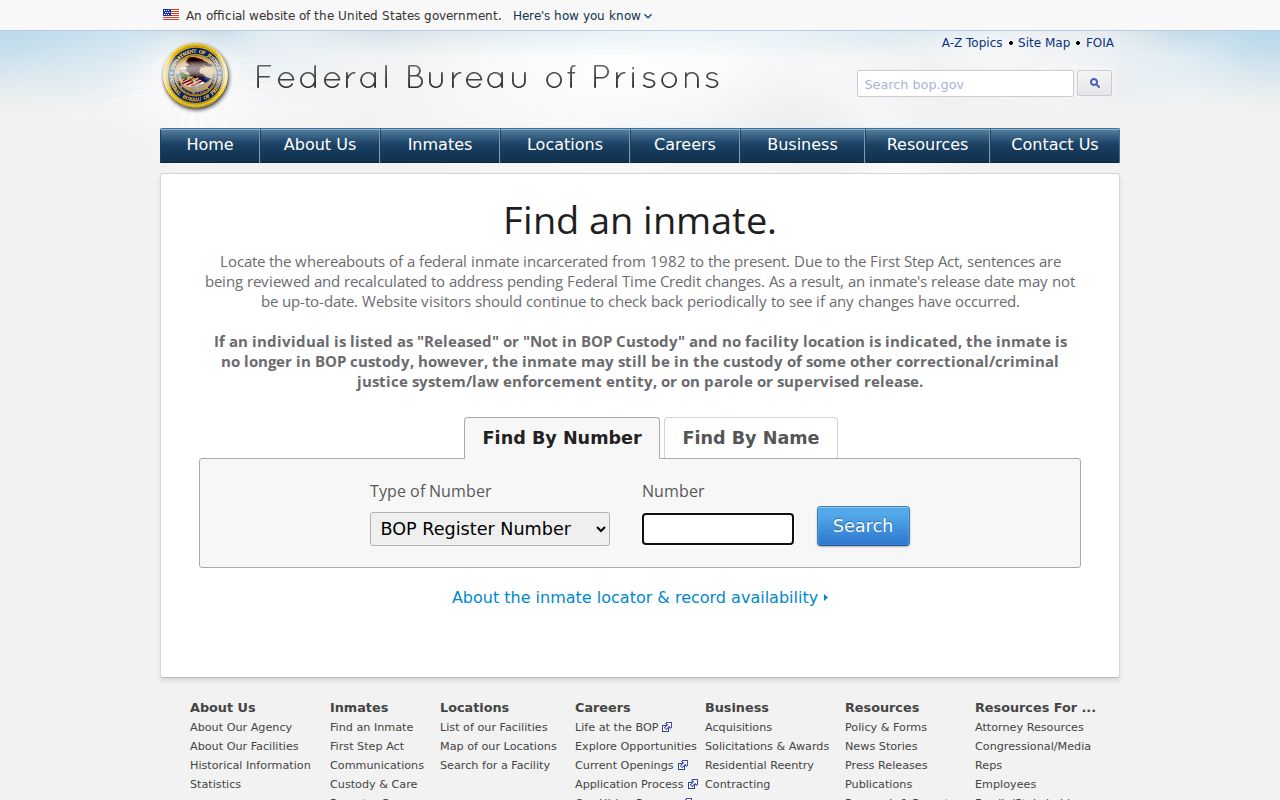
A missing result in one layer should prompt a check of transfer, release, spelling, and the proper jurisdiction.
The county facility itself was built in 2004 and has a rated capacity of 252. An IDOC inspection dated May 22, 2024 counted 158 people and listed no noncompliances. Those figures describe the facility on that inspection date, not a current roster. They help distinguish a point-in-time institutional report from the person-level custody search.
VINELink can supplement direct custody checks with notification services. It is not the source for the court judgment or the police narrative. Likewise, a public Judici entry may show a probation sentence, revocation petition, or discharge, but treatment notes, tests, home addresses, and supervision officer details are not a public online dossier.
County jail visitation and correspondence rules belong to the detention system, not the criminal case file. Visits are scheduled through the sheriff's published channel, while legal mail and money orders use the Casey Avenue address. Nonlegal mail follows a separate processing address. These operational records can confirm how the facility works, but they do not establish guilt, disposition, or the legal class of an offense.
Sealed, Expunged, and Restricted Records
Illinois treats expungement and sealing as different remedies. Expungement removes eligible records more fully, while sealing blocks ordinary public access but preserves access allowed by law. Eligibility depends on the whole record, offense, and disposition. Dismissals, acquittals, arrests without charges, and some supervision outcomes may qualify for expungement. Some convictions may qualify only for sealing.
Juvenile files follow separate rules. A missing public search result can also reflect a seal, expungement, confidentiality rule, or timing issue. It does not prove that no event occurred. The Jefferson County Circuit Clerk receives local filings, and official Illinois Courts forms should be used.
Approved forms ask for the arresting agency, arrest date, charge, case number, disposition, and the relief requested for each event. Agencies and prosecutors receive notice and may object. A judge decides disputed eligibility. Restricted personal identifiers must follow the confidential-information process required by Illinois court rules rather than being placed openly in a filing.
Jefferson County Expungement Program
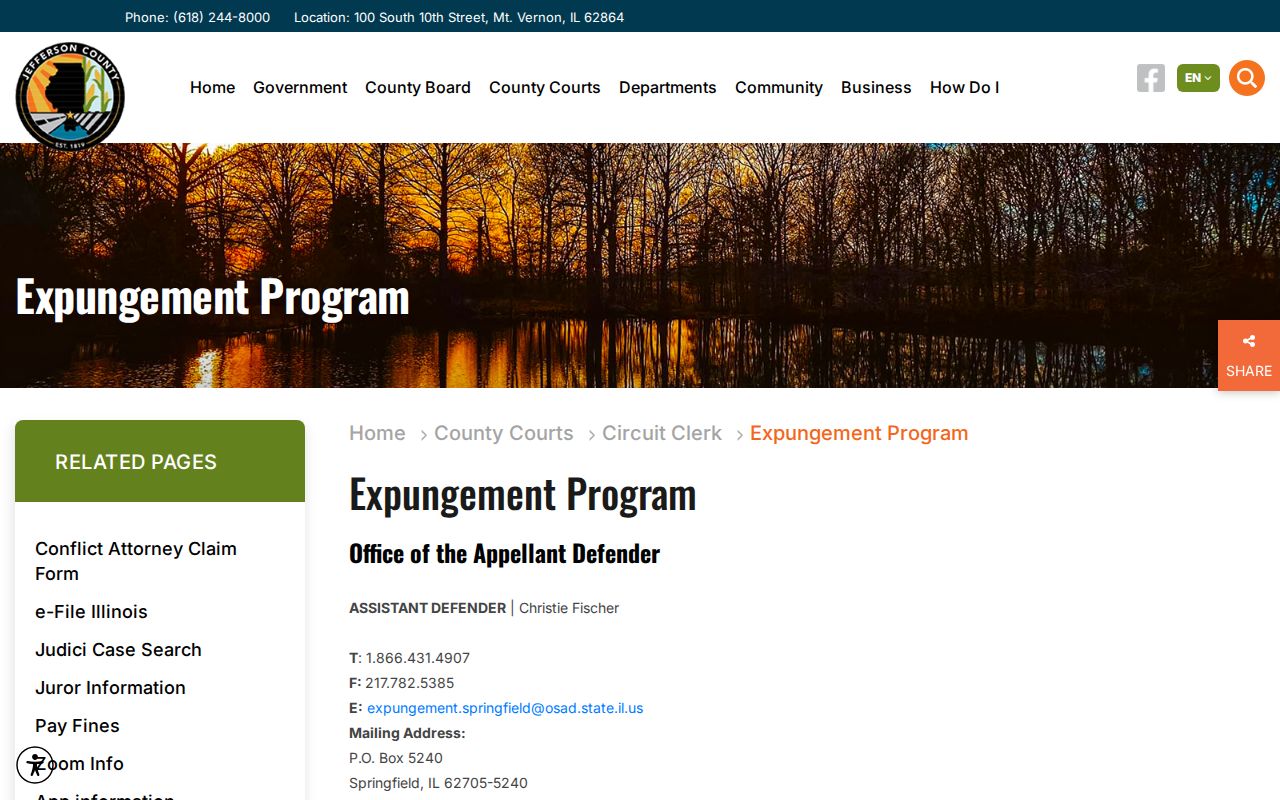
The county maintains a named Expungement Program page. It routes residents to approved forms and the Office of the State Appellate Defender. Filing takes place through the Circuit Clerk. The local filing fee was not published in the inspected official schedule, so confirm current costs before filing.
A signed order must reach ISP and the relevant clerk and arresting agencies. Portal changes may take time. Check the court file first, then use ISP Access and Review for the person's statewide transcript if a state record still appears wrong.
The county page also gives the Office of the State Appellate Defender contact: 866-431-4907 and expungement.springfield@osad.state.il.us. ISP does not charge to receive a petition, but its published fee for processing a court order to expunge or seal is $60. Court filing, service, and certified-copy charges are separate. The absence of a published local filing fee means the clerk should be asked for the current total.
A dismissal is not automatic erasure. The public docket may still show the case, the arresting agency may retain its event record, and ISP may retain a reported arrest cycle until legal relief and reporting steps are complete. First verify the disposition at the clerk. Then evaluate eligibility with the approved Illinois forms. Once an order is entered, confirm that the clerk, ISP, and arresting agency each received it before assuming every public system has changed.
Criminal Records by City in Jefferson County
Mount Vernon, Ina, and Woodlawn use different local routes. Mount Vernon Police keeps city reports, but bookings and filed cases move to county systems. Ina has village police and a separate Rend Lake College Police Department. No Woodlawn Police Department was verified, making JCSO the primary law-enforcement records route there. In all three places, filed criminal cases belong with the Jefferson County Circuit Clerk and Judici.
Mount Vernon Criminal History
14,600 at the 2020 Census · City police reports route to Mount Vernon; jail and court records route to the county.
Ina Criminal History
1,641 at the 2020 Census · Choose between village, college, sheriff, and Circuit Clerk custodians.
Woodlawn Criminal History
617 at the 2020 Census · Sheriff records and county court systems provide the main criminal-record routes.
Ina's population needs special care in any crime-rate comparison because the total includes group quarters at Big Muddy River Correctional Center. Woodlawn has no verified village police department or village-only crime series. Mount Vernon figures should be drawn from the Mount Vernon Police agency entry, not mixed with sheriff counts. Raw totals from these agencies measure different service areas and cannot be compared as though they describe the same population.
Mount Vernon is also where the two main county record buildings sit. The city became the permanent seat of justice in 1819 after William Casey donated land, and the modern courthouse continues that role. Yet city police reports remain city records. A Mount Vernon arrest can therefore require a city FOIA request, a sheriff custody check, a Judici search, and a clerk copy request. Ina records may begin with village police or Rend Lake College Police. Woodlawn requests often begin with JCSO because no village police department was verified.
The same routing principle applies beyond those three places. Identify the officer's agency from the citation, report number, or docket. Ask that agency for the narrative. Use JCSO for the county booking. Use the clerk for the filed prosecution. Use ISP only for its statewide repository products. This approach takes more than one click, but it avoids treating a partial local record as a complete history.
Jefferson County Warrant Fallbacks
The sheriff's Most Wanted page is selective. It is not a complete, live warrant database, and no comprehensive public Jefferson County warrant portal was verified.
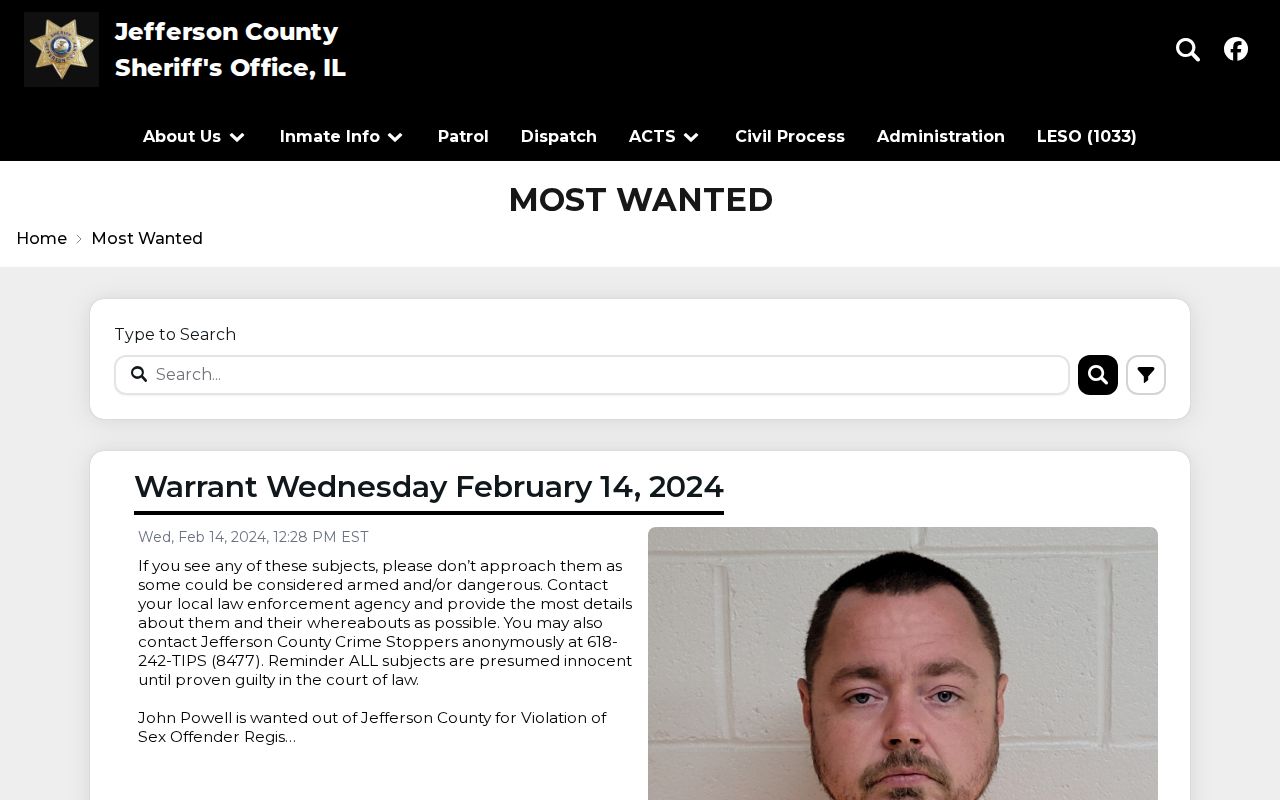
Call JCSO at 618-244-8004, review public Judici docket events, and contact the Circuit Clerk about the issuing case. A sheriff FOIA request can seek releasable existing records, though active or sealed warrant details may be withheld. Confirm status and instructions with the issuing court rather than relying on a tip page.
Ask for the case number, issuing court or judge, basis, present status, and any appearance or surrender instruction. After a court quashes or recalls a warrant, allow administrative time for law-enforcement systems to update and keep written confirmation from the clerk. Illinois has no general-public statewide warrant portal comparable to CHIRP. CHIRP reports conviction information and should not be used as a live warrant check.
Most-wanted information also needs a presumption-of-innocence check. Publication can identify a person sought by an agency, but it does not establish that the person committed the alleged offense. Verify whether the item is current before relying on it. Do not attempt a confrontation. Urgent public-safety information belongs with 911, while nonemergency status questions belong with the sheriff or issuing court.
Sealed warrants, juvenile matters, and process whose release could impair enforcement may not appear in a public response. That limit is not evidence that a warrant exists or does not exist. A lawyer can help address surrender or court appearance when needed. Once the matter is heard, the clerk's written order is the best record of the judicial action, while law-enforcement databases may need additional processing time.